Jamie MacDonald
2026-05-07 14:59:32
★★★★★
Dylan Smith was a fantastic rep! Enjoyed our conversations and he was incredibly helpful and quick to get my policy replaced with a new one. Thank you.
The average cost of auto insurance in Ontario is $2,377 per year, according to ThinkInsure customer quote data updated January 31, 2026. Ontario has the highest auto insurance premiums in Canada, with significant rate variation depending on where you live, your driving record, and the vehicle you drive.
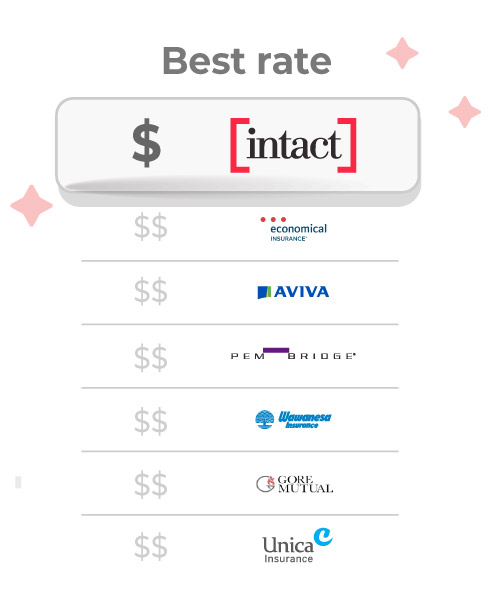
Like other drivers, you are probably tired of paying too much for car insurance rates. Comparing quotes is the best way to get the cheapest car insurance in Ontario.
ThinkInsure compares Ontario car insurance quotes from the province's top insurers so you get the lowest rate, fast. Enter your postal code to instantly compare quotes from multiple providers, or call 1-855-550-5515 to speak with an advisor today.
Current rate data is based on ThinkInsure quote submissions through January 31, 2026. See our methodology.
is the Ontario average premium
YoY increase Q4 2024 to Q4 2025
in auto rates for mature drivers (50+)
is the GTA average rate
The average cost of car insurance in Ontario is $2,377 per year ($198/month), based on ThinkInsure customer quote data updated January 31, 2026. This figure reflects what real drivers across the province are actually being quoted today.
Your location is also a key factor in how much your auto insurance will cost in the province. Car insurance in Toronto and other large cities like Mississauga or Brampton can be significantly more expensive than the provincial average. According to FSRAO, the average premium across the GTA is $2,810 per year, while rural and Northern Ontario drivers pay closer to $1,740 per year.
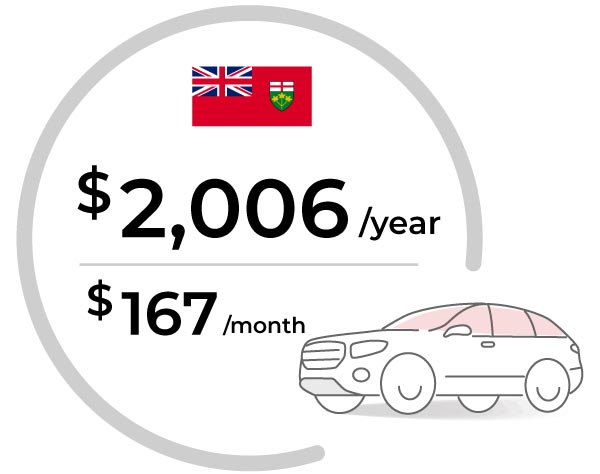
Here is an Ontario car insurance premium breakdown by different time frames:
Current rate data is based on ThinkInsure quote submissions through January 31, 2026.*** See our methodology.
Enter your postal code, vehicle, and driving information.
Instantly see quotes from multiple Ontario insurance companies.
Choose the best rate and confirm your policy details with us.
Helping Ontario drivers save on their auto insurance!
Ontario's auto insurance rules are shifting on July 1, 2026, giving drivers across the province more control over their coverage and premiums.
For the full breakdown of what is changing, who is covered, and how to decide what is right for you, see our Ontario auto insurance reforms guide.
The cheapest cities for car insurance in Ontario are Kingston, Belleville, and Chatham. The most expensive are Brampton, North York, and Ajax.
Brampton ($3,240), North York ($2,818), and Mississauga ($2,602) consistently rank as the most expensive Ontario cities. Rural and Northern cities like Belleville ($1,614), Kingston ($1,664), and Chatham ($1,668) offer the lowest rates.
According to data from FSRAO, GTA auto insurance rates are $2,810 on average. Other urban areas average $2,076. Rural areas average $1,740.
Rate variation comes down to a few key factors: more vehicles on busy roads, longer commutes, higher auto theft rates in urban areas, and the cost of claims. All of these increase insurers' claims costs and risk in larger cities.
| City | Average Annual Premium |
|---|---|
| Ontario average | $2,377 |
| Brampton | $3,240 |
| North York | $2,818 |
| Mississauga | $2,602 |
| Ajax | $2,575 |
| Whitby | $2,520 |
| Markham | $2,503 |
| Richmond Hill | $2,461 |
| Hamilton | $2,427 |
| Pickering | $2,420 |
| Aurora | $2,374 |
| Toronto | $2,346 |
| Barrie | $2,259 |
| Cambridge | $2,173 |
| Milton | $2,173 |
| London | $2,153 |
| Oshawa | $2,149 |
| Kitchener | $2,144 |
| Waterloo | $2,103 |
| Windsor | $2,065 |
| Guelph | $2,041 |
| Oakville | $2,038 |
| Brantford | $2,031 |
| Newmarket | $2,014 |
| Burlington | $2,011 |
| Thunder Bay | $1,970 |
| St. Catharines | $1,944 |
| Sault Ste. Marie | $1,876 |
| Ottawa | $1,836 |
| Sudbury | $1,824 |
| Peterborough | $1,770 |
| Stratford | $1,734 |
| North Bay | $1,705 |
| Cornwall | $1,703 |
| Chatham | $1,668 |
| Kingston | $1,664 |
| Belleville | $1,614 |
Ontario car insurance rates have increased significantly since June 2021, based on data from FSRAO. Premiums have risen across all regions, with the GTA seeing the largest absolute increases.
| Region | Oct 2025 | June 2025 | Oct 2024 | June 2024 | Oct 2023 | June 2023 | Oct 2022 | June 2022 | Oct 2021 | June 2021 |
|---|---|---|---|---|---|---|---|---|---|---|
| Ontario | $2,164 | $2,120 | $2,006 | $1,927 | $1,796 | $1,737 | $1,673 | $1,658 | $1,645 | $1,664 |
| GTA | $2,810 | $2,765 | $2,638 | $2,543 | $2,391 | $2,323 | $2,241 | $2,223 | $2,208 | $2,241 |
| Other Urban | $2,076 | $2,031 | $1,918 | $1,842 | $1,711 | $1,652 | $1,588 | $1,574 | $1,564 | $1,579 |
| Rural | $1,740 | $1,698 | $1,592 | $1,521 | $1,404 | $1,353 | $1,305 | $1,295 | $1,285 | $1,295 |
Source: FSRAO, data current through October 2025. View FSRAO premium data.
The cost of your car insurance is primarily determined by your driver profile. This risk assessment is based on factors such as your demographics, the type of vehicle you drive, and your driving history. This report uses ThinkInsure quote data to show how age, driving record, marital status, and vehicle brand affect premiums across Ontario.
Ontario car insurance rates have continued to climb through 2025 and into 2026. Data show that the average annual premium across Ontario is $2,377 based on ThinkInsure customer quote data updated January 31, 2026. Mature drivers (50+) pay roughly 18.84% less than the provincial average. Substandard drivers pay over three times the average.
This report uses ThinkInsure's internal estimated quote data through January 31, 2026 to identify critical trends across demographics, vehicle choices, and driving histories.
Ontario car insurance premiums have been on a steady upward trajectory since 2022, with significant year-over-year increases driven by auto theft, inflation, and rising claims costs.
Premiums dipped in 2022 ($2,020) compared to 2021 ($2,392), largely due to pandemic-related rate freezes and reduced driving activity. In 2023 and 2024, prices crept back to pre-pandemic levels. By 2025, the average premium had reached $2,378.
Early 2026 data shows the average premium at $2,332 for January, suggesting rate increases may moderate compared to the sharp spikes of 2024.
| Year | Avg annual premium |
|---|---|
| 2026 (Jan 1 to 31) | $2,332 |
| 2025 | $2,378 |
| 2024 | $2,203 |
| 2023 | $2,160 |
| 2022 | $2,020 |
| 2021 | $2,392 |
| 2020 | $2,272 |
| 2019 | $2,227 |
| Average rate (2019-26) | $2,248 |
Age matters for auto insurance. Older, more experienced drivers typically pay less because they are at a lower risk of filing a claim or engaging in risky driving behaviour.
Here is how they compare:
You cannot change your age. But you can change your driving habits. Focus on driving safely to maintain lower premiums.
| Driver type | Premium | Monthly | Difference |
|---|---|---|---|
| All drivers | $2,377 | $198 | 0 |
| Young drivers (25 and under) | $2,784 | $232 | 17.12% |
| Middle age (25 - 50) | $2,521 | $210 | 6.06% |
| Mature/senior drivers (50+) | $1,929 | $161 | -18.84% |
| Substandard driver | $8,092 | $674 | +240% |
Insurance companies use demographic information to assess risk.
We found that male drivers in Ontario pay slightly more than women. Males pay 2.69% more, and women pay 6.31% less than the provincial average.
Married drivers typically pay very similar premiums to single drivers, with only a 0.13% difference on average.
| Demographics | Premium | Monthly | Difference |
|---|---|---|---|
| Male | $2,441 | $203 | 2.69% |
| Female | $2,227 | $186 | -6.31% |
| Married | $2,395 | $200 | 0.76% |
| Single | $2,374 | $198 | -0.13% |
Maintaining a clean driving record is your best defence against rising premiums. It is the top factor affecting your insurance costs. One mistake can cost you.
You see a significant increase if you get a second ticket or have a second at-fault accident within a three-year period and may require high risk auto insurance.
| Driving record | Premium | Monthly | Difference |
|---|---|---|---|
| Clean driving record | $2,377 | $198 | 0.00% |
| 1 ticket in past 3 years | $2,730 | $228 | 14.85% |
| 1 accident in 3 years | $3,042 | $254 | 27.98% |
| 1 cancellation in 3 years | $3,263 | $272 | 37.27% |
| 1 suspension in 3 years | $3,834 | $320 | 61.30% |
The vehicle you choose to drive will affect your Ontario auto insurance rates. By how much? We compared customer quotes by vehicle brand and top models to find out which ones have the cheapest pricw.
Vinfast and Tesla are near the top of the list. In 2026, the high cost of specialised battery repairs and the instant-torque factor (which leads to more high-impact claims) keep EV premiums elevated.
Brands like Land Rover, Lexus, and Honda (specifically the CR-V) often carry higher rates in Ontario due to their popularity with high-tech auto theft rings.
Pontiac and Saturn are the budget kings, mostly because their remaining fleet is older, cheaper to replace, and rarely targeted by thieves.
| Vehicle Make | Average Premium | Monthly payment |
|---|---|---|
| Vinfast | $3,719 | $310 |
| Maserati | $3,592 | $299 |
| Tesla | $3,000 | $250 |
| Jaguar | $2,935 | $245 |
| Land Rover | $2,866 | $239 |
| Audi | $2,721 | $227 |
| Infiniti | $2,667 | $222 |
| BMW | $2,658 | $222 |
| Genesis | $2,645 | $220 |
| Mercedes-Benz | $2,618 | $218 |
| Lexus | $2,617 | $218 |
| Honda | $2,445 | $204 |
| Alfa Romeo | $2,440 | $203 |
| Polestar | $2,423 | $202 |
| Mazda | $2,415 | $201 |
| Mitsubishi | $2,399 | $200 |
| Toyota | $2,374 | $198 |
| Volkswagen | $2,370 | $198 |
| Hyundai | $2,360 | $197 |
| Cadillac | $2,253 | $188 |
| Kia | $2,251 | $188 |
| Jeep | $2,248 | $187 |
| Lincoln | $2,246 | $187 |
| Acura | $2,237 | $186 |
| Nissan | $2,202 | $184 |
| Dodge / Ram | $2,186 | $182 |
| Volvo | $2,175 | $181 |
| Fiat | $2,133 | $178 |
| Chrysler | $2,105 | $175 |
| Ford | $2,085 | $174 |
| Subaru | $2,065 | $172 |
| Chevrolet | $2,003 | $167 |
| Mini | $1,976 | $165 |
| GMC | $1,934 | $161 |
| Buick | $1,914 | $160 |
| Suzuki | $1,874 | $156 |
| Scion | $1,740 | $145 |
| Saab | $1,657 | $138 |
| Smart | $1,575 | $131 |
| Saturn | $1,243 | $104 |
| Pontiac | $1,034 | $86 |
Ontario auto insurance rates continued to rise in 2026, driven by auto theft, inflation, and increased claims costs. Here are the key factors pushing premiums higher.
Operating expenses rise each year due to inflation and other economic considerations. This increases the cost of liability claims, repairs, and other claims-related expenses. Rapidly rising inflation has led many Ontario insurers to request permission to increase rates from FSRAO.
Auto theft continues to be a problem. According to a news release from the Solicitor General in Ontario, a car is stolen every 48 minutes in the province.
According to the Insurance Bureau of Canada, auto theft claims increased 254% from 2018 to 2023 nationally. The most significant increase is in Ontario, where auto theft claims increased by 524% and costs surpassed $1 billion. Nationally, there were 49,679 claims and $1.5 billion in claims costs in 2023. So, Ontario accounts for about two-thirds of auto theft. CTV News reports 25,000 thefts in 2024 and close to 30,000 in 2023.
The SUVs and luxury vehicles are the main targets, with the Lexus RX Series and Toyota Highlander being the most stolen by a wide margin, according to data from Équité Association. Other common targets include RAM 1500 and Honda CR-V.
Like other consumer goods, cars are more expensive to buy in 2026 than they were a few years ago. More expensive cars are also more costly to repair.
Car features are more sophisticated, resulting in expensive parts and longer repair times. As manufacturers introduce more complicated technology (even for entry-level models), vehicle repair costs will increase. According to GISA, damage costs per claim have increased by 22.5% in the past five years and continue to increase at a rate of 7.4% per year.
Many insurers are also experiencing higher loss ratios. This means they are spending more money on paying out claims than they are generating from premiums. According to 2023 FACTS of the Property and Casualty Industry in Canada, 55% of premiums are used to pay out claims. Insurers need to increase premiums to ensure they are not operating at a loss.
There are more vehicles on the roads, and the number of accident-related claims submitted each year is on the rise. According to the Ontario Road Safety Annual Report, there were 26,993 collisions in 2023, 616 of which were fatal and 36,090 people were injured.
After 20 years of a downward trend, the number of collisions has been on the rise again since 2020.
Source: Ontario road safety annual reports (ORSAR)
Auto insurance fraud is a significant problem in the province. According to IBC, insurance fraud costs about $1.6 billion annually, up to $236 per insurance policy per year.
Customer behaviour is shifting back to pre-pandemic levels. As more vehicles travel our roads, we see a spike in the frequency of accidents, increasing auto claims. More people are commuting once again, and traffic volume has increased.
Ontarians spend more time on the road than other Canadians. The average commute time is 28.8 minutes. The longest commutes are found in larger cities.
Did you know a new car can depreciate by 20-30% in the first year alone? If your car is totalled or stolen, standard insurance only pays the car's depreciated value. This amount may not be enough to pay off your loan.
OPCF 43 waives depreciation for the first few years. This ensures that you receive a payout reflecting the original or replacement value of your car.

Ontario sets its own car insurance rules. They are governed by Ontario's Insurance Act.
Here are the basic rules and regulations you need to know:
The Financial Services Regulatory Authority of Ontario (FSRAO) is an independent regulatory agency that oversees auto insurance in Ontario. It is part of the Ontario Ministry of Finance. They oversee close to 300 insurance providers in the province.
All drivers must have at least $200,000 in third-party liability. While this is the minimum, the vast majority of drivers have significantly higher limits. Most have at least $1 million in liability because of rising costs.
This coverage protects you in the event of something bad happening, such as an accident, fraud, crime, theft, or other covered dangers.
If you are involved in an accident, report it to police and contact your insurer as soon as possible to start a claim. An adjuster will be assigned to determine fault, and your vehicle will be repaired or declared a total loss. Learn more about the car insurance claims process in Ontario.
Your policy will not cover regular maintenance, pre-existing damage, wear and tear, or damage caused while committing a criminal offence. Coverage limits and exclusions vary by policy. Speak with your advisor to understand exactly what you are protected for.
Ontario requires a minimum level of coverage, but most drivers carry more than the provincial minimums, and for good reason. Higher repair costs, vehicle theft, and rising claims expenses make proper coverage more important than ever.
Here is what your Ontario car insurance policy must include and what you should consider adding.
| Mandatory coverage | Included in all auto insurance policies | Policy limits |
|---|---|---|
| Third-party liability (TPL) | Covers liability claims against you from an at-fault accident. Basic plans have $200,000 in TPL coverage. | Coverage can be increased up to $2 million. |
| Accident benefits (AB) |
Covers the driver and passengers if injured in an accident, including costs above what OHIP covers. Includes medical, rehabilitation, attendant care, caregiver, funeral, disability income, death benefits, and income replacement. Limits apply and can be increased.
NOTE: As of July 1, 2026, several accident benefits become optional under the Ontario government's reforms outlined in the 2024 Ontario Budget. Medical, rehabilitation, and attendant care remain mandatory. Other benefits (including income replacement and caregiver benefits) become opt-in. See our Ontario auto insurance reforms guide for the full breakdown. |
Increase standard limits for both non-catastrophic ($130,000) and catastrophic ($2 million) injuries. |
| Uninsured motorist |
Also known as uninsured automobile coverage. It covers you if you are
injured by an uninsured driver or in a hit-and-run.
Standard coverage is $200,000. |
Additional coverage up to $1 million. |
| Optional insurance coverage | Coverage can be added to your policy | Recommended |
|---|---|---|
| Collision coverage | Protection if you are involved in an accident with another vehicle or an object (e.g., a tree, street sign, or light post). |
|
| Comprehensive coverage | This protects you from loss or damage from non-driving events. Coverage includes theft, vandalism, falling objects, and damage from the weather (wind, hail, flooding). |
|
| All perils | This combines collision and comprehensive. You have protection for all perils unless they are expressly excluded. | |
| Specified perils | Your policy protects all the perils listed. Anything listed is covered. This is more affordable than comprehensive while still providing most of the protection. | |
| Direct compensation property damage (DCPD) | DCPD covers damage for accidents when you are not at fault. It also covers loss of use. This is part of the no-fault system. As of January 1, 2024, drivers have the ability to opt out of this coverage using OPCF 49. |
|
| Emergency roadside assistance | Get roadside assistance when you need it. Many insurers offer this as part of their policy or as an add-on. Some services include towing, battery boost, flat tire, and more. |
| Endorsements | Coverage to customize your policy | Recommended |
|---|---|---|
| Agreed value of automobiles (OPCF 19A) | Insurers agree to pay a specific amount if your vehicle is a total loss. | |
| Transportation replacement (OPCF 20) | Covers rental car insurance and transportation if your vehicle was stolen or while getting repaired. |
|
| Rental car coverage (OPCF 27) | Coverage for when you drive vehicles that are not your own, such as a rental car. |
|
| Accident forgiveness (OPCF 39) | Protects your driving record after your first at-fault accident. Your first collision will not impact your premiums. |
|
| Waiver of depreciation (OPCF 43) | Insurers cannot deduct depreciation from your vehicle's value when making a claim. |
|
| Family protection (OPCF 44R) | Covers you or your family if you are injured, even if you're not in the car when the accident happens. |
|
| Agreement Not to Recover for Loss or Damage from an Automobile Collision (OPCF 49) | Removes DCPD coverage from your policy. |
Insurers offer a wide range of discounts for auto insurance in Ontario. Ask about the discounts you may qualify for to lower your premiums:
Install winter tires on your vehicle.
Save up to 5%
Insure all your vehicles with the same insurer.
Save up to 10%
Park in your private garage or driveway.
Save up to 8%
Get rewarded for your good driving habits.
Save up to 30%
Complete an approved driver education program.
Save up to 10%
Drive an eco-friendly vehicle and save more.
Save up to 10%
Shop and compare car insurance quotes in Ontario and find lowest rates from top insurers. Getting a quote is free and only takes a couple of minutes.
Get startedBeing a good driver and taking proactive steps to reduce your premiums will help you get better rates. Here are some great tips to help you get the cheapest car insurance in Ontario:
There are many insurance companies in Canada, and their prices change often. Shopping around allows you to compare quotes to see if you are overpaying. Get a quote today and see how much you can save.
Combine your home and auto insurance into a single policy. You will automatically qualify for savings of up to 20%. Combining is the best way to save.
Renewal time is the perfect opportunity to look for new ways to save money. It is also a great time to update your information and ensure you have the right level of coverage.
Things change, including the types of car insurance discounts you qualify for. Always ask about available discounts for additional savings.
Winter driving can be challenging and dangerous. By simply using winter tires, you can improve safety, have peace of mind, and save money.
Completing a ministry-approved driver training program will help you obtain a better price. Be sure to inform your insurance company of this to save more.
If it makes sense for you, raise your deductible to lower your rates. The more you increase your deductible, the lower your auto insurance premiums.
Keeping your driving record clean is one of the most effective ways to save. Driving safely will save you money now and in the future.
The type of vehicle you drive matters. Look for vehicles with a strong safety rating, lower repair costs, and security features.
Missing a payment can affect your rates. If you consistently miss payments, your insurer could cancel your policy. You can save even more by paying in full instead of making monthly payments.
Park in a private garage or driveway. This makes your vehicle less likely to get stolen, damaged, or vandalised.
Some insurers offer a green discount for people who drive hybrid or electric vehicles. Electric car insurance rates depend on the vehicle.
You can save up to 25% when you use a telematics device to monitor your good driving habits. Several insurers offer usage-based insurance programs. They include Intact My Drive, Aviva Journey, Travelers IntelliDrive, and Pembridge My_BRIDGE.
If you belong to a certain group (employer, school, association), review your options to identify potential cost-saving opportunities.
Vehicle theft is a serious issue in Ontario. Adding insurer-approved anti-theft devices can qualify you for savings.
Car insurance prices are calculated using many different factors. Your rate can vary significantly based on these considerations and the information you provide. Here are the main factors insurance companies use to calculate rates:
Based in the GTA and serving Ontario drivers for over 50 years. Get local Ontario car insurance coverage expertise.
RIBO licenced advisors give you straight, non-biased advice, not pressure to sell one company's product.
Compare quotes from Ontario's top auto insurance providers in minutes. One conversation, multiple quotes and the lowest rates.
Get exceptional customer service. We like happy customers and have a 4.7/5 Google rating.
There is no single company that offers the cheapest car insurance rate. Some companies prefer good drivers and others will accept a couple of accidents or tickets. Some offer fair prices in cities, while others do in rural areas.
Companies also change their rates often based on claims experience and other considerations they use to determine premiums. A good way to find out who has the best price is to compare car insurance quotes from multiple Ontario providers.
On July 1, 2026, most accident benefit coverages in Ontario will shift from mandatory to optional under your auto insurance policy. This gives drivers more control over their coverage but also means you could be underinsured if you do not review your policy before the changes take effect. Medical, rehabilitation, and attendant care remain mandatory. Other benefits (including income replacement, caregiver, and housekeeping benefits) become opt-in. Speak with a ThinkInsure advisor to understand how the changes affect you. See our Ontario auto insurance reforms guide for the full breakdown.
You must be 16 years of age to be eligible for a driver's licence. The province operates using a graduated driver's licencing system.
You must complete all levels to become fully licenced. The G1 is your learner's permit. You must be at least 16 and pass a written test. A fully licenced driver must accompany you when driving. It is recommended that people with this licence be added to a parents' or guardians' plan to pay less.
To obtain a G2 licence, you must have your G1 for one year. It can be 8 months if you complete a driver training course. With this licence, you can drive alone. Coverage can be expensive because of your age, relative inexperience, and the chance of being in a collision.
To obtain a full G driver's licence, you must have your G2 for at least one year. You must pass the G2 exit test. No restrictions apply if you are over 21. At this point, you will see some savings.
If you are an experienced driver, adding a new driver will raise your next quote. Teenagers with a G1 or G2 pay the highest amount. Ensure they take a driving course to help lower your premium.
You are required to provide information about your driving history. Here is a list of the documents you need to get car insurance:
Your provider may request additional information to complete your quote.
Yes, usage based insurance is available in Ontario. Several insurers offer telematics programs to help you save. CAA, Intact, Aviva, Travelers and Pembridge offer products that reward you for safe driving practices.
Accident forgiveness is a feature available for auto insurance. It is an optional coverage that allows you to have one at-fault accident without affecting your rate. It is a great form of protection to add. Everyone makes mistakes. One mistake behind the wheel could spike your insurance. Accident forgiveness protects your premiums.
It is viewed as a way for an insurance company to reward good habits behind the wheel and are claims-free. Not all companies offer this perk. To qualify, you must be in good standing, have a clean record, and meet other criteria.
Your auto insurance coverage in Ontario follows the vehicle, not the driver. Anyone you permit to drive your vehicle is insured under your policy. This also means that the claim will go on your record if they are in an accident.
For example, you lend out your vehicle to a family member to run to the store to pick up a few things. On their way back from the store, they get into a collision. Even though they are a licenced and insured driver, the accident claim would still fall under you because your insurance is tied to your vehicle, regardless of who is operating it.
Yes, there are situations where you can be denied or refused insurance. An insurance company can deny you standard auto insurance coverage in Ontario. Typically, this will happen if you have been charged for driving offences (DUI, careless driving, etc.), have too many claims, or have had payment issues in the past.
Even if you are refused, you have the right to receive a written reason why you were denied. If you have been denied, there are still ways for you to get insured. You can still qualify for high-risk insurance or through the Facility Association.
You do not need insurance to own a vehicle. But if you plan to drive it, you will need licence plates, and you cannot get plates without proof of insurance. So, you will need coverage to register your vehicle in the province. Learn more about registering a vehicle in Ontario.
No, consumers do not have to pay harmonised sales tax (HST) on car insurance. However, they do have to pay an insurance premium tax. The rate in the province is 3%, one of the lowest in Canada.
Extreme weather events are more common: flooding, flash freezes, hail, strong winds, and severe storms. Does insurance cover weather damage to a car? It depends on your level of coverage. You will be covered if you have a comprehensive or all-perils plan. Otherwise, you may not have protection from weather damage.
Get a ticket? Were you the cause of an accident? These things go on your driving record. But for how long? A moving violation will stay on your record for 3 years. An accident will stay on your record for up to 6 years. How much an offence will affect your rates will depend on the severity of the infraction and your insurer.
No. Credit score checks are not required to buy car insurance in Ontario. They also do not have any impact on the price of premiums.
If you are at-fault for a collision in Ontario, you are responsible for causing the crash, damage, or injury. There are varying degrees of fault. You can be 50%, 75%, or 100% at-fault. This means more than one driver can be at-fault. If you are found to have some fault, your insurance could be increased.
You can protect yourself from a rate increase after your first at-fault accident by adding accident forgiveness coverage.
Learn more about at-fault accidents.
You are required to have proof of insurance when operating a vehicle. If you are pulled over by the police or get into an accident, you will need to show proof of insurance.
You can show a paper copy (your pink slip) or proof of coverage using your smartphone. If you cannot show proof, you could face a fine of up to $500, even if you have a valid policy. So, make sure you know where your insurance card is before you drive.
Standard insurance policies are valid for one year from the date they are enacted. This is the minimum length of a policy in the province. You cannot buy temporary insurance in the province. If you have a specific need, speak with your insurer. Alternatively, you can talk with our advisors about your options. We will ensure you get the right coverage for your situation.
There are situations where your insurer can cancel your auto insurance. They can have your insurance cancelled for non-payment or if they find out you lied on your application. Companies can also choose not to renew at the end of the term. If you have been cancelled, we can help. Give us a call to discuss your options.
You have just been involved in an accident. What do you do next? Do you have to report it? How do you do it?
The laws in Ontario require you to report the accident if the vehicle involved suffers more than $5,000 in damage, someone is injured, or a crime was committed.
Get more information: Collision Reporting Thresholds Increase in Ontario.
Here are the main steps to report an accident in Ontario:
Yes. As of January 1, 2024, Ontario drivers can opt out of Direct Compensation Property Damage (DCPD) coverage using OPCF 49. Opting out lowers your premium, but it means you will not be compensated for damage to your vehicle in not-at-fault collisions. Most Ontario drivers should keep DCPD coverage. Speak with a ThinkInsure advisor before making this decision.
Industry estimates suggest opting out of newly-optional accident benefits could lower your premium by approximately 5%. However, opting out can mean losing access to tens of thousands of dollars in coverage if you are injured. Medical, rehabilitation, and attendant care benefits remain mandatory. Income replacement, caregiver, and housekeeping benefits become opt-in as of July 1, 2026. Speak with a ThinkInsure advisor before deciding what to keep or remove. See our Ontario auto insurance reforms guide for the full breakdown.
Based on January 31, 2026 ThinkInsure customer quote data, the cheapest Ontario cities are Belleville ($1,614), Kingston ($1,664), Chatham ($1,668), Cornwall ($1,703), and North Bay ($1,705). Rural and Northern Ontario cities consistently have the lowest premiums because they have lower traffic density, fewer collisions, and lower auto theft rates than the GTA and other urban centres.
With premiums on the rise, it is understandable that people want to know who the best car insurance companies in Ontario are. There are many good companies, so it is challenging to offer a definitive list because there is so much variation in what they offer in terms of products, rates, claims services, discounts, and coverage options.
Fortunately, we have partnered with the top insurance companies in Ontario and across the country. Our team has worked closely with these brands for years. Our customers have also built loyalty with these providers over time. Here are some of the leading insurance companies we can get you quotes and coverage with:
The most important thing is that you find the auto insurance company that is best for you. So, it is important to get quotes from multiple insurers. This way, you can see which offers you the lowest price for the coverage you want.
Our RIBO licenced advisors have got you covered for finding the best auto insurance rates and coverage. Get non-biased auto insurance advice, personalised coverage, and the lowest rates with a local Ontario insurance broker.
Our advisors will ensure you have proper coverage for your unique Ontario driving needs.
We will instantly compare quotes and discounts from Canada's top auto insurance providers to find you the lowest rate. By comparing quotes, we help Ontario drivers save an average of $981*.
Choose the provider that offers the best coverage and rate for your needs. We often can get you insured with a new automobile policy on the same day.
Call us if you have complex coverage needs, need to renew today, or want to insure multiple vehicles. We often can get you insured with a new automobile policy on the same day.
Worried about one mistake impacting your car insurance rates? I recommend considering Accident Forgiveness, an optional endorsement that protects your premium from increasing after your first at-fault accident. This coverage is particularly good for drivers with clean records who want to maintain their preferred rates. Ask if adding Accident Forgiveness is a good fit for your policy to safeguard your rates.
Monday-Friday: 8am-6pm
Disclaimer:
* Based on the difference between the average lowest premium and the overall average premium in Ontario for estimates completed from January 31, 2025, to January 31, 2026.
** Estimated premiums from 2019-2026.
*** Estimated premiums are based on data entered by drivers on ThinkInsure.ca through January 31, 2026.
Read our insurance blog to get helpful tips, information and news.
The cost of owning a car has surpassed $1,000 per month. Here’s how you can calculate how much it costs to own a car in 2026.
Accident forgiveness car insurance is increasingly common today, and it is a feature offered by many companies in Ontario. Here's what you need to know about before signing up, and how to qualify.
Big changes are coming with Ontario’s auto insurance reforms. Starting July 1, 2026, many accident benefits will become optional. Learn how these reforms may impact your automobile coverage.
Learn about Comprehensive Insurance in Ontario. We’ll explain comprehensive insurance policies, how much it costs and when you need it. Get answers to common questions about this type of car insurance.